Bias monitoring is more than a fairness score
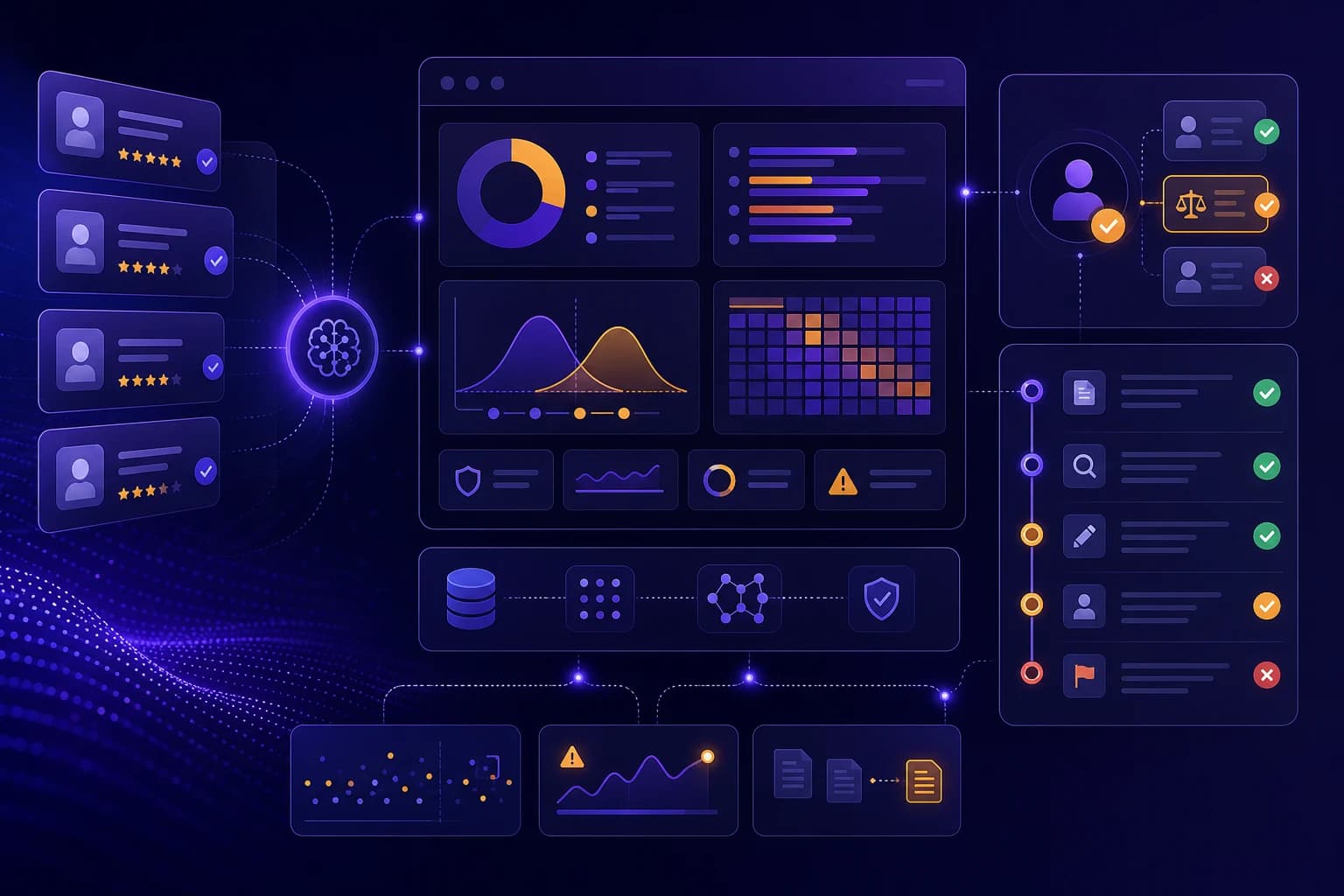
Many HR-tech vendors now show a fairness dashboard. It contains charts, percentages, segments and sometimes a warning when the distribution looks skewed.
That is useful, but not enough. A dashboard without decision-making is decoration. Bias monitoring for CV screening and matching must lead to questions, corrections, escalation and an audit trail. Otherwise you may see that a problem exists, but later you cannot explain what you did about it.
For HR-AI, this matters. Recruitment affects access to work and is listed in the AI Act high-risk domain of employment, worker management and access to self-employment[3]. That requires more than a periodic screenshot.
Start with the decision being influenced
Bias monitoring only works when you know which decision the system supports.
For CV screening, that may be:
- which candidates become visible to recruiters;
- which candidates receive a high matching score;
- which profiles are excluded by knockout criteria;
- which candidates are invited to interview;
- which candidates are rejected before human review.
For matching, the signals may include skills, experience, location, language, availability or salary indication. Each signal may seem neutral on its own, but in combination it can become a proxy for age, gender, ethnicity, disability, caring duties or socioeconomic background.
Bias monitoring therefore does not start with the model. It starts with the question: which human opportunity can this score reduce?
Measure input, output and behaviour
A good bias monitoring process looks at three layers.
1. Input data
What goes into the system? CVs are messy. Candidates use different formats, language levels, job titles and writing styles. Some candidates have career gaps, foreign degrees, volunteer work or non-linear careers.
Monitor:
- missing fields;
- parsing errors;
- language detection;
- degree and job title mapping;
- treatment of career gaps;
- fields that may act as proxies.
2. Model output
Which scores, labels or rankings come out? Here you look at distributions and deviations.
Monitor for example:
- average score by group or relevant proxy;
- ratio between application pool and shortlist;
- rejection after knockout question;
- changes after model updates;
- differences across locations, roles or seniority levels.
3. Human behaviour
Bias can also emerge after AI has produced output. Recruiters may blindly follow the top 10, hiring managers may treat AI scores as objective, or teams may record overrides only when the outcome is positive.
Monitor:
- how often recruiters follow AI output;
- how often they override it;
- which reasons they give;
- whether overrides affect certain groups more often;
- whether complaints or correction requests return to the same vacancy or tool.
Define thresholds before the debate
A dashboard becomes governable only when it is clear in advance what requires action. Define thresholds.
Examples:
- a group is structurally underrepresented in the shortlist compared with the application pool;
- a model update reduces scores for a specific language or experience group;
- a knockout rule excludes many candidates without a clear role requirement;
- recruiters almost never override AI output;
- complaints repeatedly concern the same filtering step.
Without thresholds, bias monitoring becomes an argument after the fact. With thresholds, it becomes a process.
Record corrections as an audit trail
The most important part is not the measurement. It is the response.
For every relevant deviation, record:
- what was detected;
- which data or group was affected;
- who reviewed the analysis;
- which hypothesis was tested;
- which correction was made;
- when it will be measured again;
- which communication to candidates, workers or vendor is needed.
This does not need to be a heavy report. A compact decision log is often enough. The point is that you can later show that monitoring led to control.
Involve the vendor, but do not make it the only owner
Much of the bias data sits with the vendor. That does not mean the vendor owns the full risk.
The deployer knows the context: vacancy, target group, labour market, selection criteria and human review. The vendor knows the system: features, model version, validation and technical limits. You need both.
Include in vendor arrangements:
- which bias metrics are provided by default;
- which segments or proxies are available;
- how model updates are reported;
- which incidents or deviations are shared;
- how quickly the vendor supports root-cause analysis;
- which exports are available for your evidence pack.
Connect monitoring to training
Bias monitoring only works when users understand the signals. A recruiter who does not know what proxy discrimination is may treat a postcode effect as ordinary market data. A hiring manager who treats AI ranking as objective will not challenge it.
Training should therefore include scenarios such as:
- two candidates with similar experience but different CV style;
- foreign degrees being mapped lower;
- career gaps caused by caring duties;
- language that is scored as "less professional";
- a model update changing shortlist distribution.
For Article 4 evidence, training is stronger when it shows not only completion, but also scenario results and role-based competence.
A pragmatic 30-day approach
In the first month, you do not need a perfect fairness lab. Start with a workable audit trail.
Week 1:
- inventory where CV screening or matching happens;
- identify which scores influence decisions;
- request vendor information about data, model and monitoring.
Week 2:
- choose the three most important bias indicators;
- define thresholds for review;
- create a short decision log.
Week 3:
- train recruiters and hiring managers on AI output review;
- start override logging;
- test a first shortlist for obvious patterns.
Week 4:
- discuss findings with HR, legal/privacy and vendor;
- record corrections;
- plan the next monitoring round.
Embed AI uses this approach in the HR-AI Risk & Evidence Sprint. Staffing firms can use the specific route for recruitment agencies.
Final note
Bias monitoring is not an Excel check after the fact. It is the connection between data, human judgement and demonstrable improvement.
An organisation with only a dashboard can say it looked. An organisation with an audit trail can show it acted. For HR-AI, that is the difference that matters.